This is a follow-up to the teardown of Apple's pre-order cover page, which was about the machine that holds the door shut. This one is about what was behind it.
I checked the cover one last time at 11:57 UTC. The shield had gone live worldwide, msg_1 was staged in the payload, and the context still read full. Three minutes later the gate opened. By 12:59 the cover URL was answering 303 and redirecting into the shop, and the Hong Kong payload read cv: default, cctx: live — exactly the terminal state the constant table predicted.
The machine worked. The allocation behind it is a different story.
What I actually measured
Eight availability queries across five markets, between twenty and thirty-four minutes after pre-orders opened at 12:00 UTC on Saturday 12 September. Every screenshot was taken with a time.is panel beside it, so each timestamp is independently checkable rather than taken on trust from a system clock.
| # | Clock | T+ | Region | Model | Price | Pickup | Delivery |
|---|---|---|---|---|---|---|---|
| 1 | 20:20:44 | +20m | US — New Vienna, OH | Pro Max 1TB Burgundy | $1,899 | The Greene, Beavercreek, 33.63 mi — Fri Sep 18 | — |
| 2 | 20:21:59 | +22m | JP — 〒100-0005 | Pro Max 1TB バーガンディ | ¥344,800 | 丸の内 0.37km, 銀座 0.56km, 表参道 4.9km, 新宿 5.59km — all 9月18日 | — |
| 3 | 20:23:10 | +23m | SG — 569933 | Pro 1TB Burgundy | S$2,799 | Orchard 7.48km, MBS 9.59km, Jewel 15.75km — all 18 Sept | — |
| 4 | 20:23:22 | +23m | SG — 569933 | Pro Max 1TB Burgundy | S$2,999 | MBS 18 Sept; Orchard and Jewel unavailable | — |
| 5 | 20:25:24 | +25m | CN — 深圳 | Pro 1TB 勃艮第酒红 | ¥15,499 | 万象城 3.35km 9/18; 前海壹方城 25.69km 9/19; 天环广场 105.07km 9/19; 益田假日 暂无供应 | — |
| 6 | 20:25:41 | +26m | CN — 深圳 | Pro Max 1TB 勃艮第酒红 | ¥16,499 | 最近 5 家零售店今日无货 | 10月8日 |
| 7 | 20:34:04 | +34m | HK — Central | Pro Max 1TB Burgundy | HK$16,799 | Not available at 6 nearest stores | 09/10–16/10 |
| 8 | 20:34:19 | +34m | HK — Central | Pro 1TB Burgundy | HK$15,799 | ifc mall 0.69km 19 Sept; Canton Rd 2.34km 20 Sept; Causeway Bay 3.26km 19 Sept; Festival Walk 6.27km unavailable | — |
All clocks are UTC+8. Screenshots 3 and 4, 5 and 6, and 7 and 8 are matched Pro versus Pro Max pairs taken twelve to seventeen seconds apart, which makes them clean controlled comparisons rather than separate observations.
One methodological note that matters later. Screenshot 7's fallback list reported Pro 1TB Burgundy as available at one store, while the direct query fifteen seconds later named three. The fallback list is filtered more tightly than the direct query. Where the two disagree, the direct query is the figure I trust.
It is one SKU, not a shortage
This is the strongest thing in the dataset, and it survives every caveat below.
| Market | Pro Max 1TB Burgundy | Pro 1TB Burgundy | Gap |
|---|---|---|---|
| HK | 0 / 6 | 3 / 4 | total |
| CN | 0 / 5 | 3 / 4 | total |
| SG | 1 / 3 | 3 / 3 | partial |
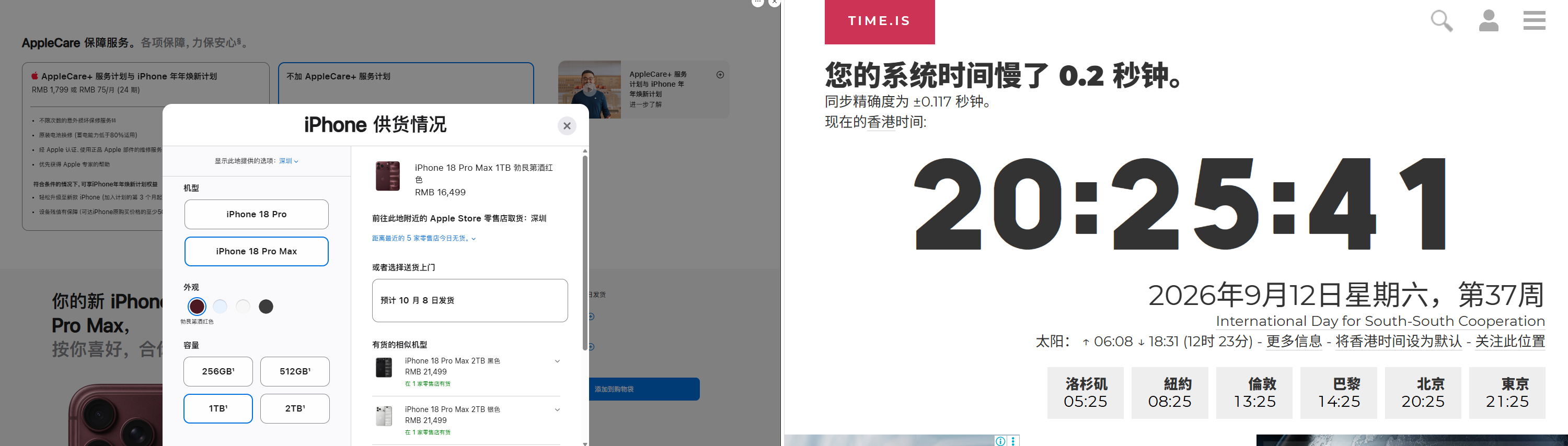
Shenzhen at T+26m. No stock at the five nearest stores, delivery pushed to 8 October, and the similar-models panel underneath still offering Pro Max 2TB in black and silver at one store each.
That panel is the clincher. With Pro Max 1TB Burgundy at zero across five Shenzhen stores, Apple is simultaneously offering Pro Max 2TB in black and in silver, each available at one store, for ¥21,499. There are Pro Max units physically sitting in Shenzhen retail. They are the wrong tier and the wrong colour.
That single observation rules out two explanations at once. It is not a general supply constraint, because Pro Max exists in the building. It is not a Burgundy finish bottleneck either, because Burgundy Pro is available at three stores in the same city minutes earlier. The demand is landing on one coordinate: Pro Max, 1TB, Burgundy. Hero colour, sweet-spot storage, and the configuration with the deepest resale demand and the narrowest tolerance for substitution.
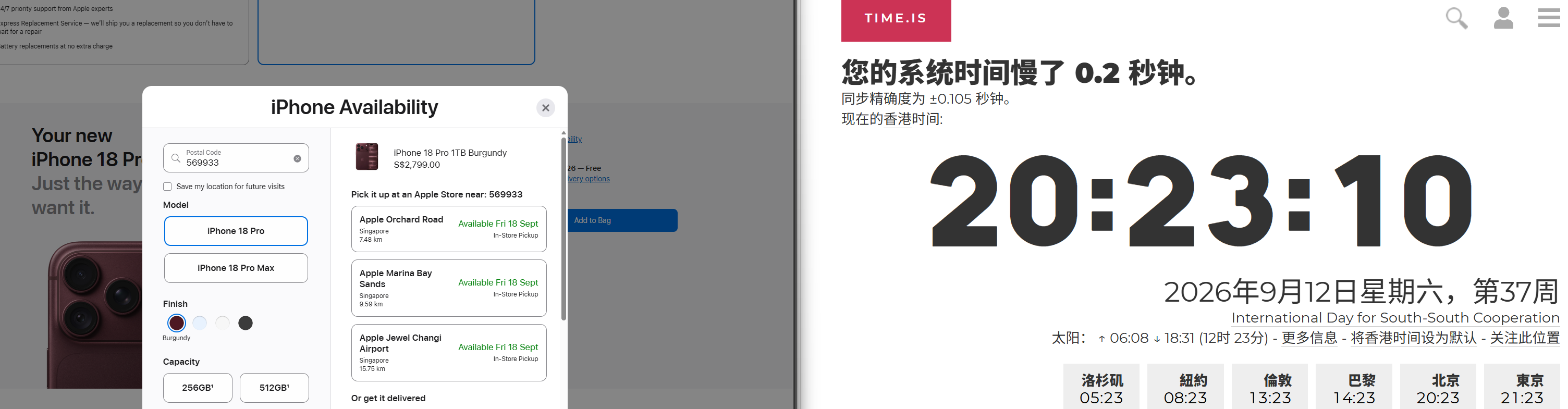
Singapore, Pro 1TB Burgundy at T+23m. Three stores out of three, all on launch day.
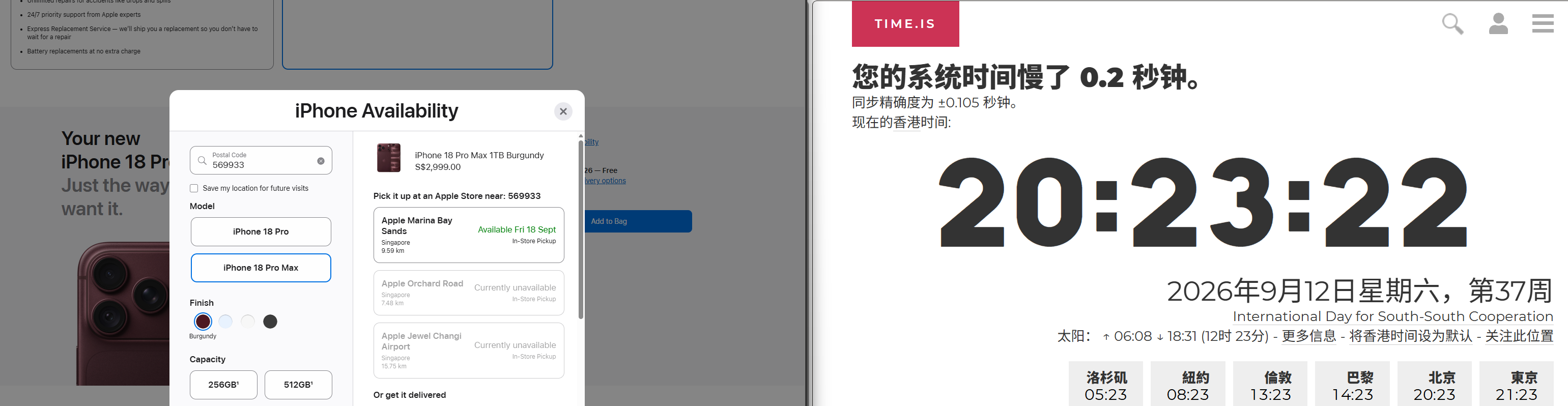
The same postal code twelve seconds later, one tier up. Marina Bay Sands survives, Orchard Road and Jewel Changi are already gone.
Hong Kong and Shenzhen are tied at the bottom, but Hong Kong is the better evidence
Both sit at zero on Pro Max with delivery pushed into October. Hong Kong looks marginally worse on paper, at 9 to 16 October against Shenzhen's 8 October, but the Hong Kong snapshot is eight minutes later and some of that gap is simply extra drain time. Treat them as tied.
What makes Hong Kong the more meaningful reading is geography. Shenzhen's five-store list had to stretch 105 km to 天环广场 in Guangzhou to reach five stores at all. Hong Kong's six sit inside a territory you can cross end to end in under an hour, with four of them within 6.3 km of Central. Hong Kong offers a denser and more genuinely reachable store set than anything else in this dataset, and it still returned zero.
Adjusted for density, Hong Kong is the tightest market here by a clear margin.
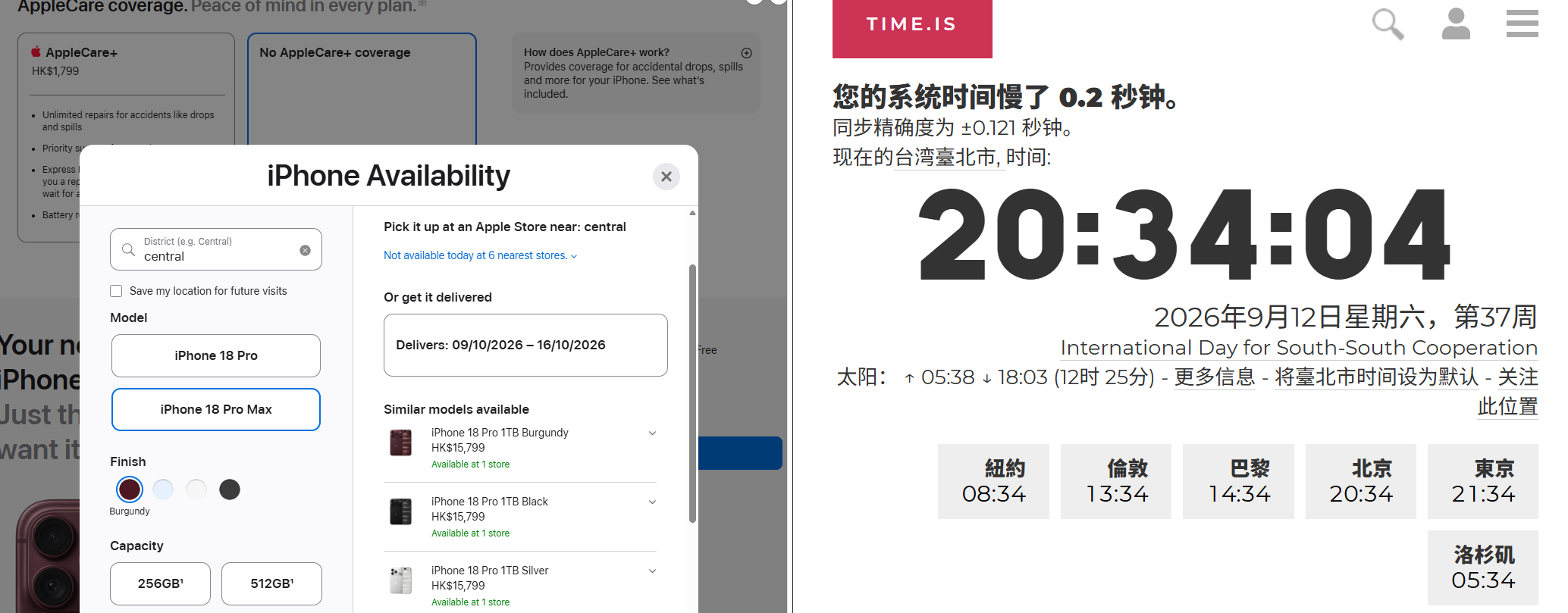
Hong Kong Central at T+34m. Six stores, nothing, and a delivery window running to 16 October.
Hong Kong is behind across the whole Pro line
This one is easy to miss, because it hides inside the good news.
Everywhere else in the dataset, anything reported as available said 18 September. Launch day, flat, no slippage. In Hong Kong the Pro units that are in stock say something else:
| Store | Distance | Pickup |
|---|---|---|
| Apple ifc mall | 0.69 km | 19 Sept |
| Apple Causeway Bay | 3.26 km | 19 Sept |
| Apple Canton Road | 2.34 km | 20 Sept |
| Apple Festival Walk | 6.27 km | unavailable |
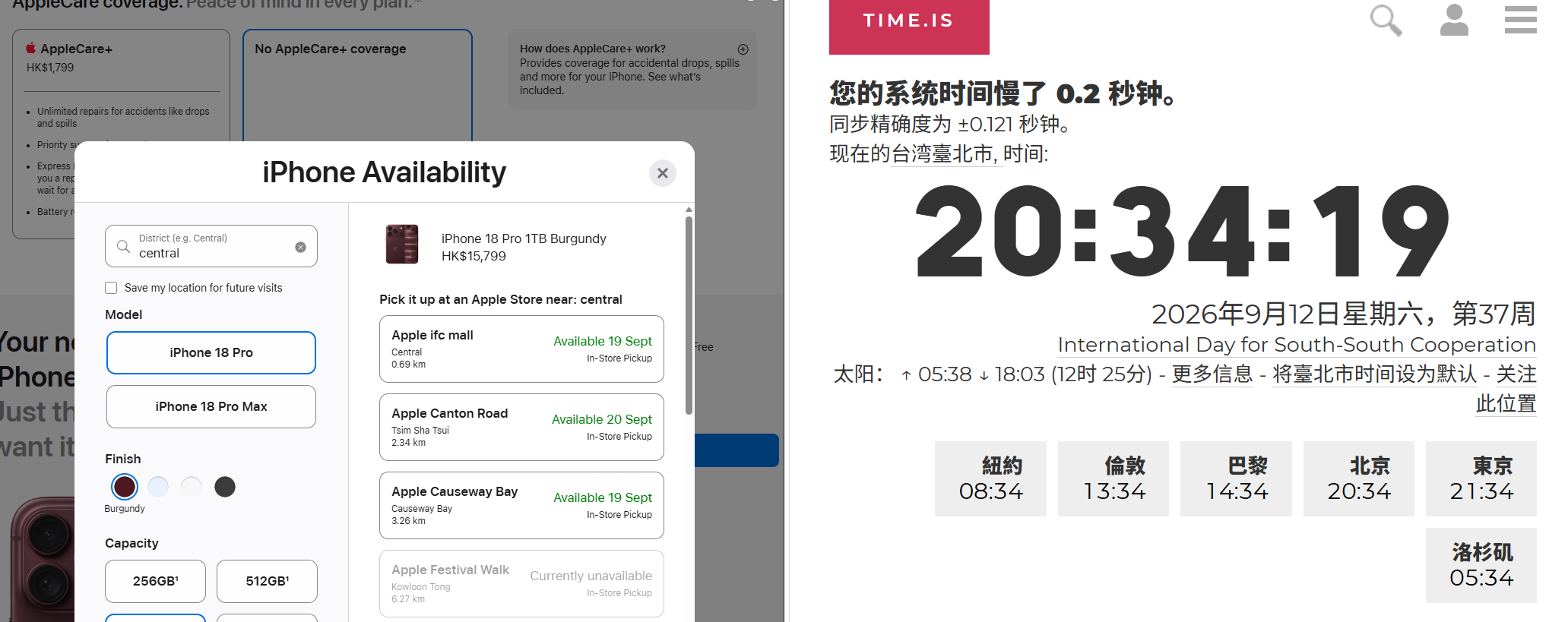
Fifteen seconds after the previous shot, one tier down. Available, but one to two days past launch.
Shenzhen shows a milder version of the same shape, with 万象城 on 9/18 but 前海壹方城 and 天环广场 both slipping to 9/19. Tokyo, Singapore and Ohio show no slippage at all.
So Hong Kong is not a market where one SKU sold out. It is a market where the entire Pro allocation is running behind demand, and Pro Max is merely the part that has already gone.
Why Hong Kong and Shenzhen specifically
Tax structure is the engine. Hong Kong is a free port with no VAT, no GST and no sales tax. Every other market here bakes consumption tax into the shelf price.
| Region | List price | ≈ USD | vs HK | Tax status |
|---|---|---|---|---|
| HK | HK$16,799 | ~$2,154 | baseline | No VAT or GST, free port |
| CN | ¥16,499 | ~$2,300 | +6.8% | 13% VAT included |
| JP | ¥344,800 | ~$2,300 | +6.8% | 10% consumption tax included |
| SG | S$2,999 | ~$2,330 | +8.2% | 9% GST included |
| US | $1,899 | $1,899 | −11.8% | Pre-tax, state sales tax at checkout |
Conversions use approximate mid-September rates and are indicative only. The US row is not comparable to the others as displayed, since US shelf prices exclude sales tax.
HK$16,799 converts to roughly ¥15,400, about seven percent under mainland list, on a device that is otherwise identical and three hours from Shenzhen by rail. That differential is the entire economic basis of the 水貨 trade and has been for two decades.
Channel concentration. In the US and Japan a large share of iPhone volume moves through carriers, which bleeds launch-day demand away from Apple's own retail allocation. In Hong Kong and mainland China, Apple's direct channel carries far more of the day-one load, and the pressure lands precisely on the pickup slots I was querying.
The 代搶 layer. Reporting from 9 September had proxy-buying services quoting ¥199 to ¥499 for mainland allocation and ¥1,000 to ¥1,500 for the Hong Kong version, two to three times the mainland rate, with operators instructing clients to register fresh Apple IDs for each attempt. I could not verify this independently, so treat it as reported rather than measured. If it is accurate, the premium is the market pricing Hong Kong as the hardest allocation to obtain, which is the same conclusion the availability data reaches by a different route.
Store density per capita. Shenzhen plus Guangzhou is an enormous population served by a handful of stores. Central Tokyo had four flagships inside 6 km all holding stock. That comparison is fair. The Ohio comparison is not, and I want to be explicit about it: New Vienna is rural with the nearest store 33 miles out, so one available store there proves far less than four available stores in Marunouchi. Ohio's apparent success reads as low local demand, not strong supply.
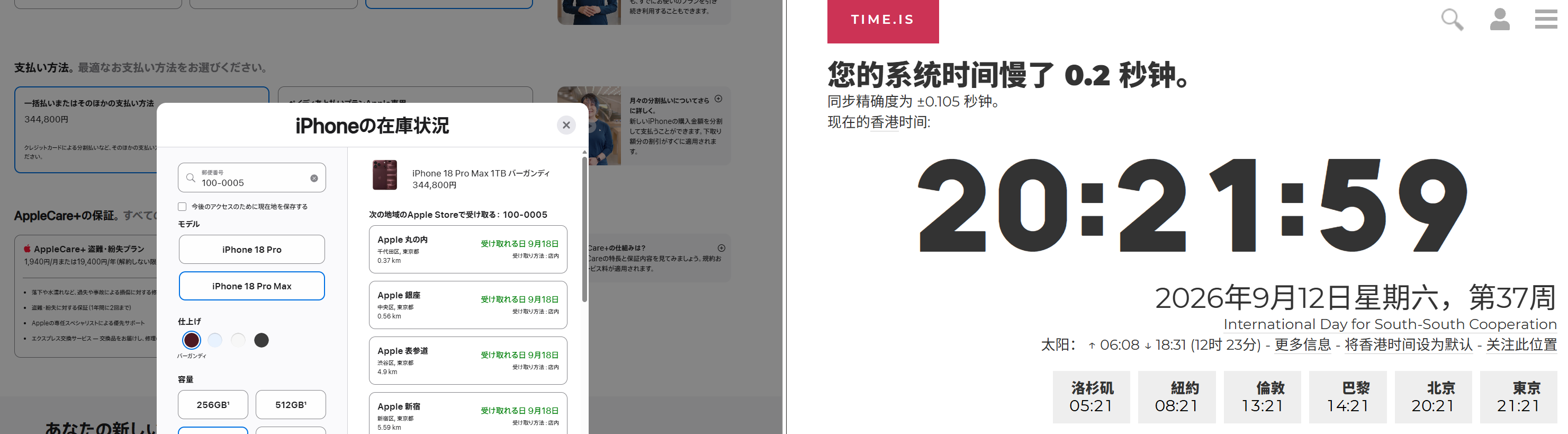
Tokyo at T+22m. Four flagships within 5.6 km, every one of them holding the exact SKU that was already gone in Hong Kong.
The published purchase limit is not binding at launch hour
Hong Kong is one of very few Apple storefronts that published a per-customer cap for this launch: two Pro and two Pro Max, alongside the strictest terms in the set. No returns at all, a policy changed in August 2017 explicitly to suppress scalping. A 15% restocking charge on late cancellation. Hong Kong billing addresses only, no freight forwarders, personal identification required at pickup, and refunds only to a name-matched Hong Kong bank account.
And it is still the most drained market in the dataset.
Two per customer, set against organised proxy demand reportedly paying four figures per slot, simply does not bind hard enough to matter in the first half hour. The cap's real function looks retroactive rather than preventive. Apple's Hong Kong terms make the confirmation email explicitly not an acceptance, with acceptance occurring only at "Preparing for Shipment", plus a discretionary right to refuse, cancel or delay on reasonable grounds of non-end-use. The limit does not gate the queue. It gives Apple licence to unwind orders afterwards.
The most interesting number is HK$1,000
Pro 1TB Burgundy is HK$15,799. Pro Max 1TB Burgundy is HK$16,799. A step of 6.3%.
What that 6.3% currently buys, in Hong Kong, is the difference between walking into ifc mall on 19 September and waiting until somewhere between 9 and 16 October. A four-week gap, for a six percent price difference, purchased at the same instant from the same storefront.
That ratio is itself diagnostic. When a modest price step produces a step-function change in availability, the demand is not being driven by price-sensitive consumers, because consumers substitute at the margin and the margin here is small. It is being driven by buyers who need one exact configuration and are indifferent to a six percent cost difference. That is the signature of resale rather than end use.
What this dataset cannot tell you
I would rather state the limits than have someone else find them.
Each figure is a single query per region per model, from one postal code, at one instant. It is not a stock census. Locator granularity varies by market, with the US searching by city or ZIP, Japan by 郵便番号, Singapore by postal code, mainland China by city dropdown and Hong Kong by district, so the store radii these produce are not equivalent to each other. The timing spread across the set is fourteen minutes and Hong Kong is last, so some of its apparent disadvantage over Shenzhen is drain time rather than underlying difference. The US snapshot is a weak comparator for the reason given above. Screenshot 7's fallback count contradicted screenshot 8's direct query because the two use different filters.
Most importantly, Apple publishes no stock levels, no allocation figures and no sell-out data, for any region, in any year. Everything here is inference from an availability endpoint that reports a boolean per store and says nothing whatsoever about depth. A store showing available might have four units or four hundred.
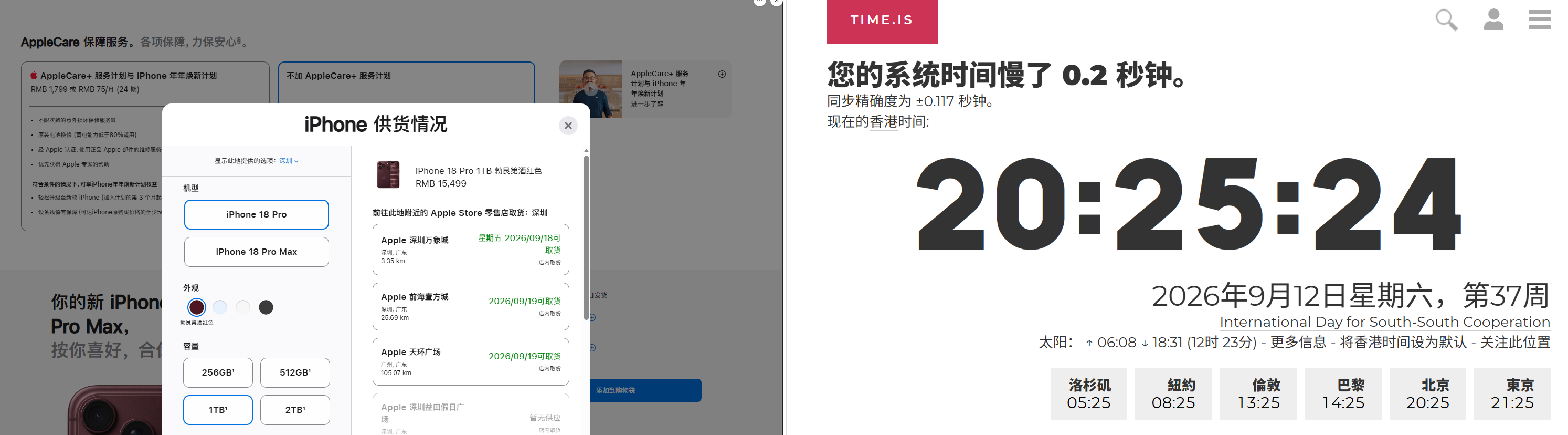
Shenzhen, Pro 1TB at T+25m. Available, but reaching 105 km to Guangzhou to fill out the list.
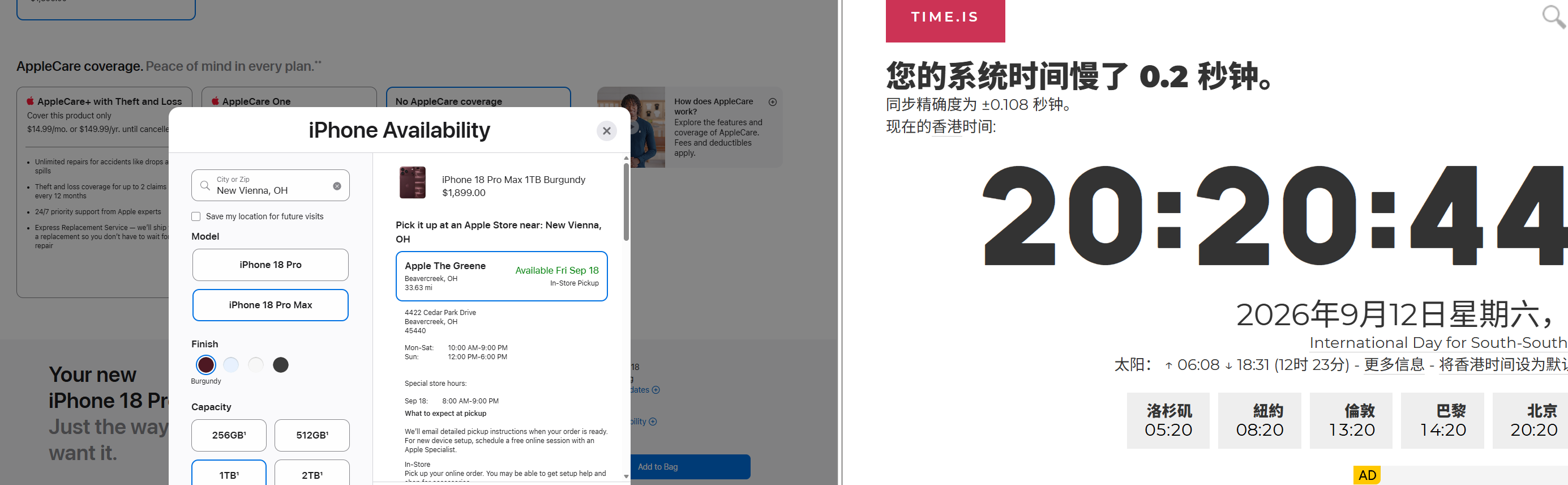
Rural Ohio at T+20m. One store, 33 miles out, launch day. The weakest comparator in the set and included for honesty rather than strength.
One forward-looking note
Shenzhen's Pro Max delivery estimate of 8 October lands after 国庆 golden week entirely. That timing pushes mainland demand toward Hong Kong pickup on the 18th to 20th, which is exactly the window where Hong Kong's already-slipping Pro allocation will be under the most additional pressure.
The previous article was about a waiting room engineered down to a five-second cookie gap, a proof-of-work challenge and a copy ladder written to manage your mood. All of that worked. It held a few million people politely in place and let them in on cue.
Then the door opened, and in one market the thing everyone was queueing for had been gone for twenty minutes.
Quantum Responses