They say everyone in Guiyang has a relative who lives in Huaguoyuan.
That may be no joke. The Huaguoyuan complex holds a number of Chinese records: it is the nation's largest shantytown redevelopment, with more than 20 sub-districts and over 300 high-rises above 40 floors, and was at one point the biggest residential complex in the country (its planned area exceeds Beijing's Tiantongyuan and Huilongguan combined). On 1% of Guiyang's urban land it houses a tenth of the city's population. In 2017 Guizhou posted 10.2% GDP growth, the fastest of any province in China. And for the people who come to Guiyang, Huaguoyuan offers an affordable, dignified place to live [1].
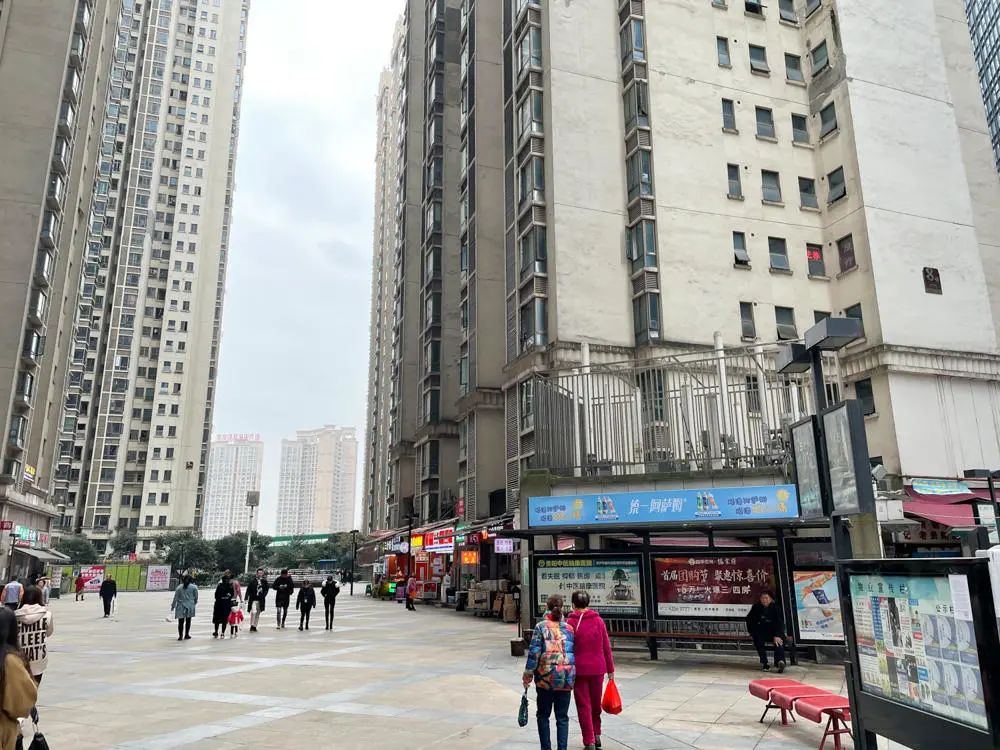
Huaguoyuan is also called "Asia's No.1 legendary complex" because its extreme floor-area ratio pushes the limits of high-rise living. Amid the concrete jungle, crews are busy rolling out 5G towers. So how is the phone signal there?
Come along — my 5G phone and I will take you through it.
Author: Liu Dongyu / Editor: Li Tuo / Planning: the Fangdadelg team
"Once you're inside Huaguoyuan, nobody finds their way without navigation," joked our host from China Tower's Guizhou branch, who had invited us. Eighteen million square meters of floor space, average building height 40 floors, a million comings and goings a day... numbers that capture what makes Guiyang's Huaguoyuan, "China's No.1 legendary complex", so different.
We felt Huaguoyuan's power right at the entrance: cars were already bunching up off-peak on the steep ramp into the complex. The slope told us this is a community built against a mountain — in fact, it is exactly this hilly terrain with little flat land that gave this southwestern provincial capital, no less mountainous than Chongqing, its distinctive skyline of high-rises everywhere.
The place is surreal in three ways. First, "big": possibly the largest residential complex in Asia, so famous that in Guiyang it is practically true that "everyone has a friend or relative living in Huaguoyuan". Second, "dense": the gaps between towers only fit narrow footpaths, and the 200-plus towers reach an extreme floor-area ratio of 6.8. Third, "contrast": modern life set against a not-so-humane community environment — under the ultra-high density, shops everywhere and delivery riders weaving through show how residents and managers use modern means to offset the inherent downsides of hyper-density.
Modern life runs on navigation and delivery apps, of course — riders, Didi drivers and the stall owners dotted through the residential and commercial towers all need signal. But a place this dense is visibly hard to cover:
The extreme population density and foot traffic demand a lot from base stations.
Crammed buildings limit each base station's coverage.
Thousand-household towers are hard to serve from indoors, so coverage must rely on limited public areas.
Residential and commercial towers coexist with different network demands.
And the car parks — up to four floors underground, linking the towers — need coverage too...
Not to mention 5G itself is harder to build: weaker penetration, smaller cell radius.
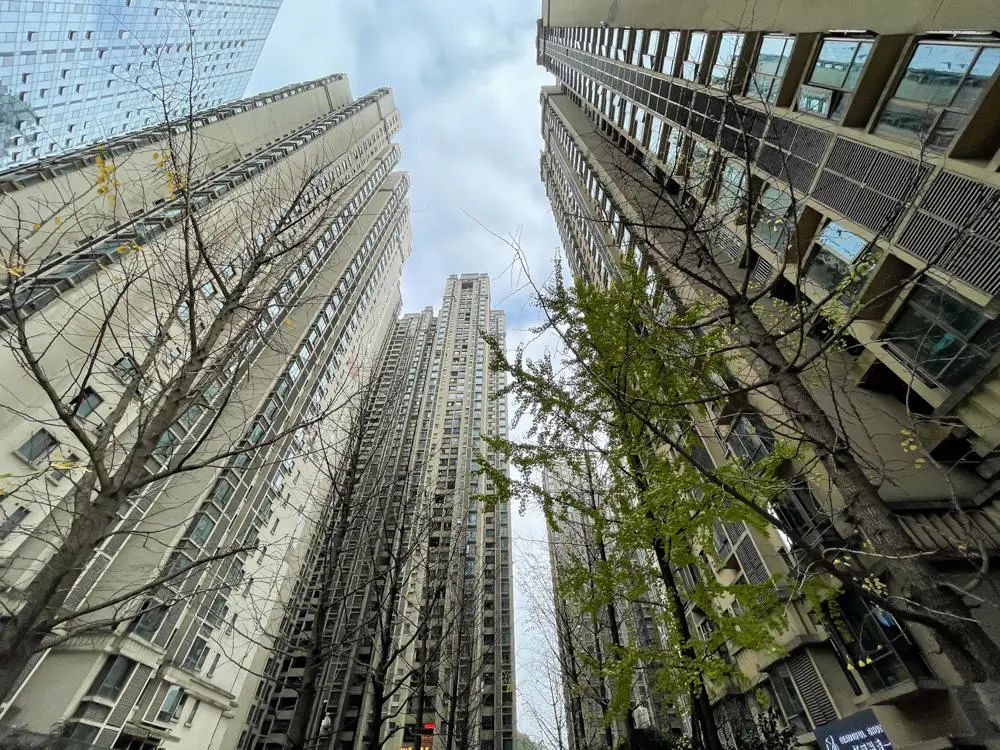
Hard, but not impossible. This year Huaguoyuan finally achieved full 4G coverage — from the 40-plus-floor towers down to the fourth underground parking level — and 5G construction is being pushed forward as a showcase project.
Where does the phone signal come from?
According to China Tower's Guizhou branch, building networks in a complex like this means solving a series of engineering problems. The key idea is to split the community vertically into high, middle and low layers, and deploy different technologies in each. Cao Deguo, project manager at China Mobile's Guiyang branch, summarized the plan as "macro and micro cells combined, high and low layers paired, indoor and outdoor coordinated".
The three vertical layers are covered differently.
The "middle layer" — ground level and lower-to-mid residential floors — is mainly served by macro base stations on the ground. Thanks to signal penetration (4G penetrates better than 5G), the middle layer is relatively easy to deploy and was the first to be covered.
But in "surreal" Huaguoyuan, ground base stations are constrained by the terrain. Building spacing is the biggest limit: we found a small macro station in a passage between buildings, and staff explained its antennas can only cover the narrow corridor between two towers and residents up to a dozen or so floors. In open terrain, a typical base station like this covers an area several hundred meters across.
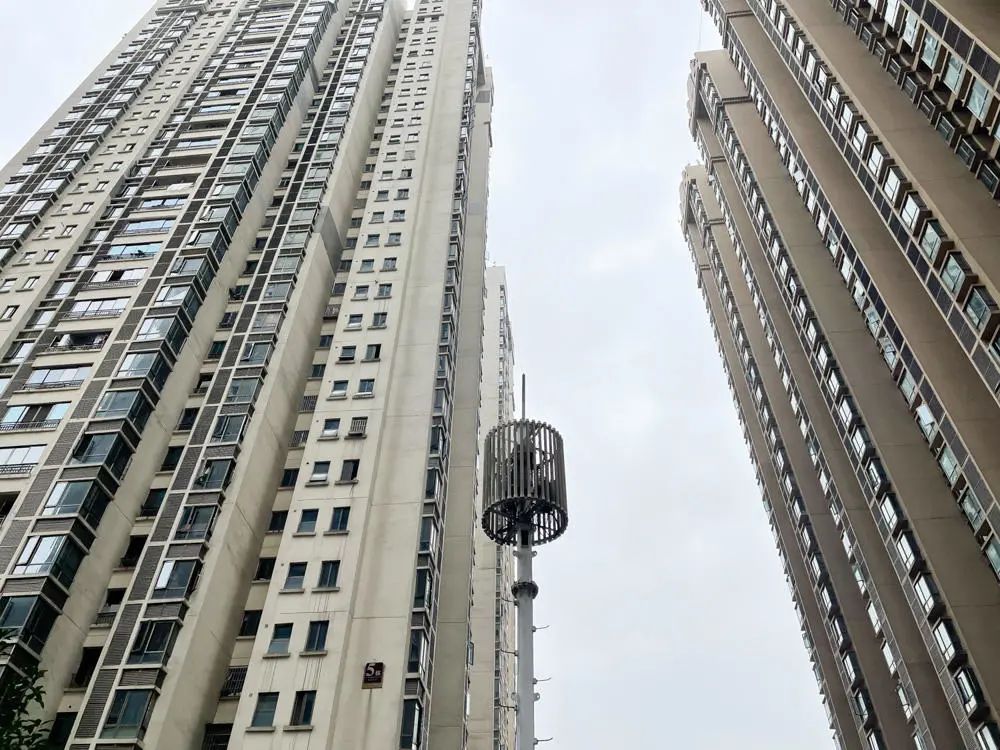
Huaguoyuan's towers are typically forty floors tall; the space above them is the "high layer", covered by antennas on rooftops firing downward to serve the upper floors of surrounding buildings. They cannot cover the building they sit on, though — which is why these antennas are vividly described as "buildings shooting at each other".
From the ground we could just make out the shooting-pair antennas on roofs more than a hundred meters up. This year, many newly installed high-rise shooting pairs have contributed greatly to Huaguoyuan's coverage.
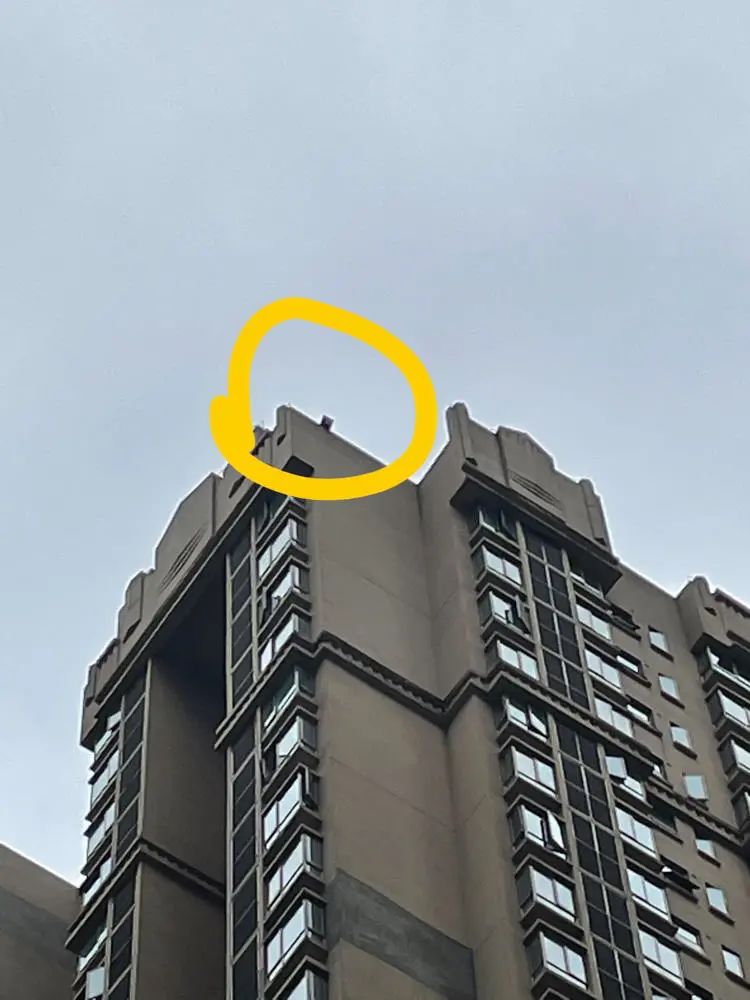
Antenna shooting pairs have another advantage: they're cheaper. Previously, indoor signal for high floors could only come from distributed antenna systems — the "mushroom" antennas you see in offices, basements and subway stations — which require engineers to run cabling on every floor, at great expense. According to Guiyang Tower's estimates, rooftop shooting pairs improved coverage by 8% while cutting costs by 34%. Across Huaguoyuan, this high-layer design alone saved the industry 43.09 million yuan.
Even so, many buildings in Huaguoyuan — commercial towers, for example — are too large for outdoor stations (ground macros and rooftop pairs) to reach their centers, so indoor distribution systems remain a key part of the network: the "indoor-outdoor coordination". Especially for 5G, whose weaker penetration needs indoor systems to fill the gaps.
At the community's "low layer" — the basement — coverage comes entirely from indoor distribution. In another underground garage in Guiyang we saw something new: leaky-cable antennas, originally used in subway and rail tunnels, innovatively applied to underground car parks — a device that merges cable and antenna into one.
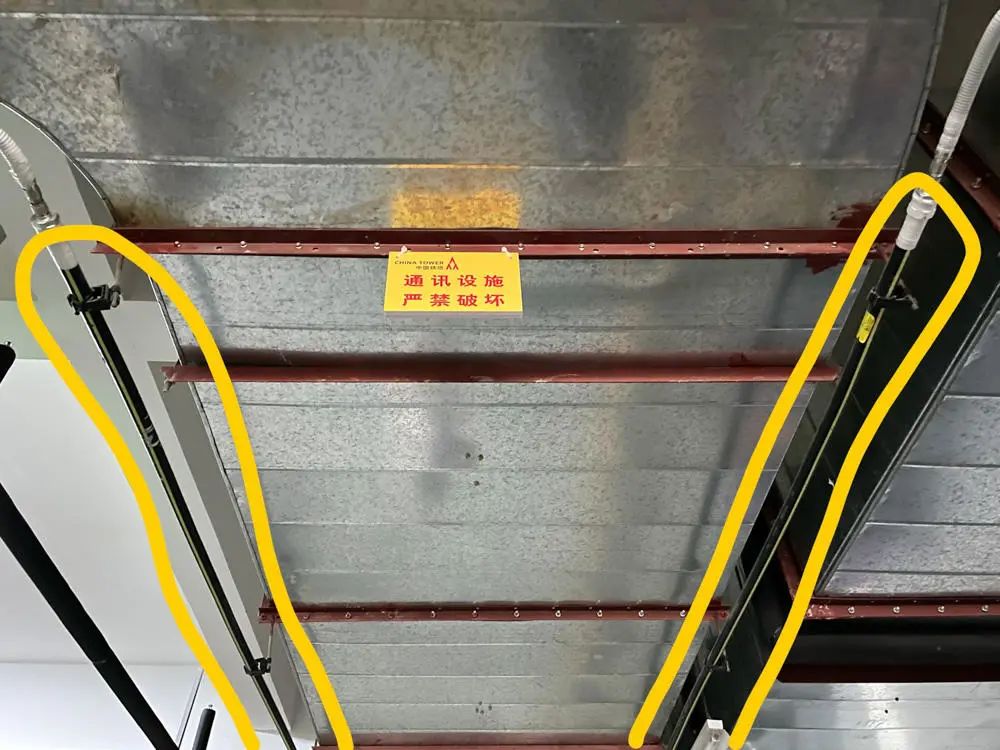
Although leaky cable itself costs more than traditional indoor antennas, this linear antenna is naturally compatible with a building's piping, so construction costs drop sharply. All in, covering one car park's signal with this new antenna costs just 15% of the original indoor distribution system.
So what does it cost to give a million people phone signal?
For this enormous community, the three major carriers and the tower company poured in huge manpower and resources to achieve basic 4G ubiquity and push 5G forward. According to the tower company, Huaguoyuan is Guizhou's first urban complex with fully planned 5G — the model room for building networks in complex communities across the province.
Zhai Xiang of China Tower Guizhou's communications development department disclosed the project's budget: if the three carriers each built Huaguoyuan's 5G independently, it would cost about 720 million yuan in total; with one party leading and all three sharing equipment under unified planning, it takes just 300 million. To date the tower company and carriers have invested 160 million yuan and built over 300 base stations (4G + 5G) covering the Huaguoyuan area.
Coordinated construction has another benefit: it dramatically cuts the cost of negotiating with property managers during construction. Zhai said that with the tower company coordinating, the carriers' deployment in Huaguoyuan achieved "three waivers and one reduction" — no coordination fees, no entry fees, no site rent, and cheaper electricity — saving the carriers 2.28 million yuan a year in operating costs.
The tower company's founding mission was precisely to merge the three carriers' network construction into one, built once and shared. In Huaguoyuan, a 5G indoor distribution system shared by all three is another way to save money and roll out quickly.
Thanks to the strong sharing capability of today's common passive indoor distribution systems, China Tower can build the passive lines and antennas and let all three carriers connect. You can think of a passive indoor system this way: in a room in a building's basement sit all three carriers' devices, linked by fiber to the backbone; every "mushroom head" in the building is simply an antenna fed from that room. Active systems need power at every antenna; a passive one is just an antenna.
Within Huaguoyuan alone, the shared 5G indoor distribution system saves the industry 167 million yuan of duplicate construction investment — a 67% saving from three builders down to one. On rent, it cut the carriers' capital expenditure by 76.63 million yuan, a 91% reduction.
On August 20 this year, China Mobile and the tower company proposed a batch of 5G base stations for Huaguoyuan — 199 stations in the Guiyang Huaguoyuan 5G phase-2 project. By September 13 all stations were planned; on September 15 coordination with the property side was complete; and by mid-November 64 of the sites had been delivered, averaging 720 Mbps download.
Is 5G rolling out fast enough? Some people have only just got 4G.
Under the "faster, cheaper internet" agenda, 5G will indeed change our lives. But while we agonize over whether 5G is available, many people still need basic 4G coverage — in the Bijie mountain region of Guizhou, for example.
Xia Youzhi, general manager of China Tower's Bijie branch, told us that over the past two years Bijie built two batches totaling 3,177 base stations, bringing full 4G coverage to more than 6,000 natural villages of 30+ households. One batch of 958 stations was requested on August 6 this year with delivery required by the end of October; of those, 736 stations in key poverty-alleviation areas had to be live by the end of September. Bijie Tower and Bijie Mobile raced the clock, scheduling backwards from the deadline, and finished the 958 4G base stations of the sixth "telecom universal service project" batch in 68 days.
We visited one 4G base station that uses the mountain itself as the tower. Building it was no easier than covering Huaguoyuan with 5G: there was no road up the mountain, so concrete and tower parts went up by shoulder and horse; rain in Guizhou's mountains turns paths to mud, so crews worked under rain canopies... That is the difficulty for a single station — and within the two-month window, hundreds more like it were being built at the same time.
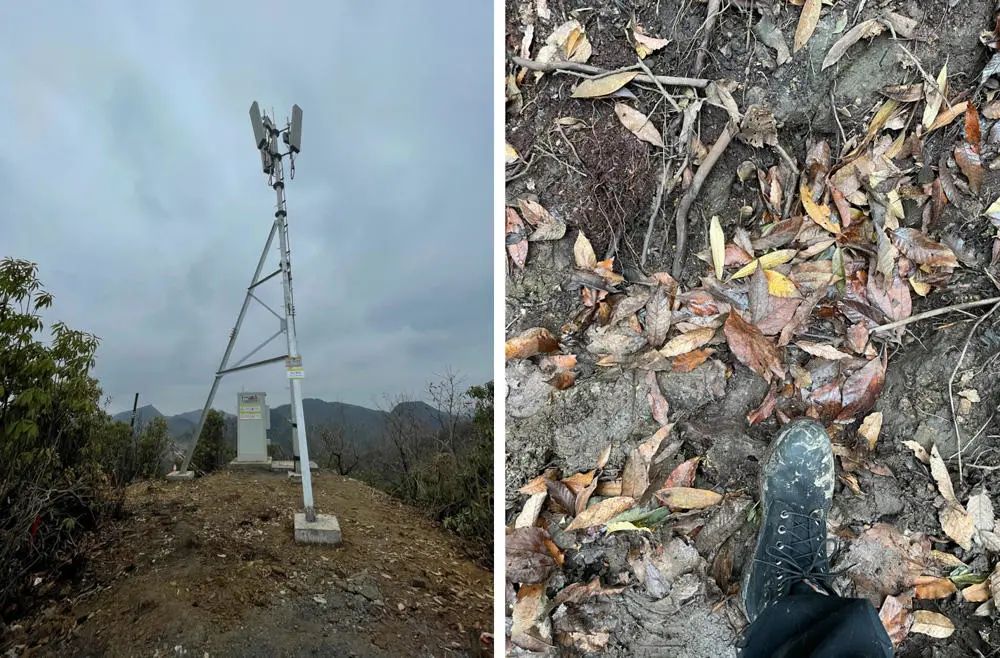
During the pandemic these stations carried critical needs like online classes for the area. The station we visited alone provides essential data to two surrounding villages. This humble tower shape is rarely seen in cities; but thanks to its demountable structure and outdoor all-in-one cabinets, the station costs only 98,000 yuan. Building a tall mast on lower ground would roughly double the cost.
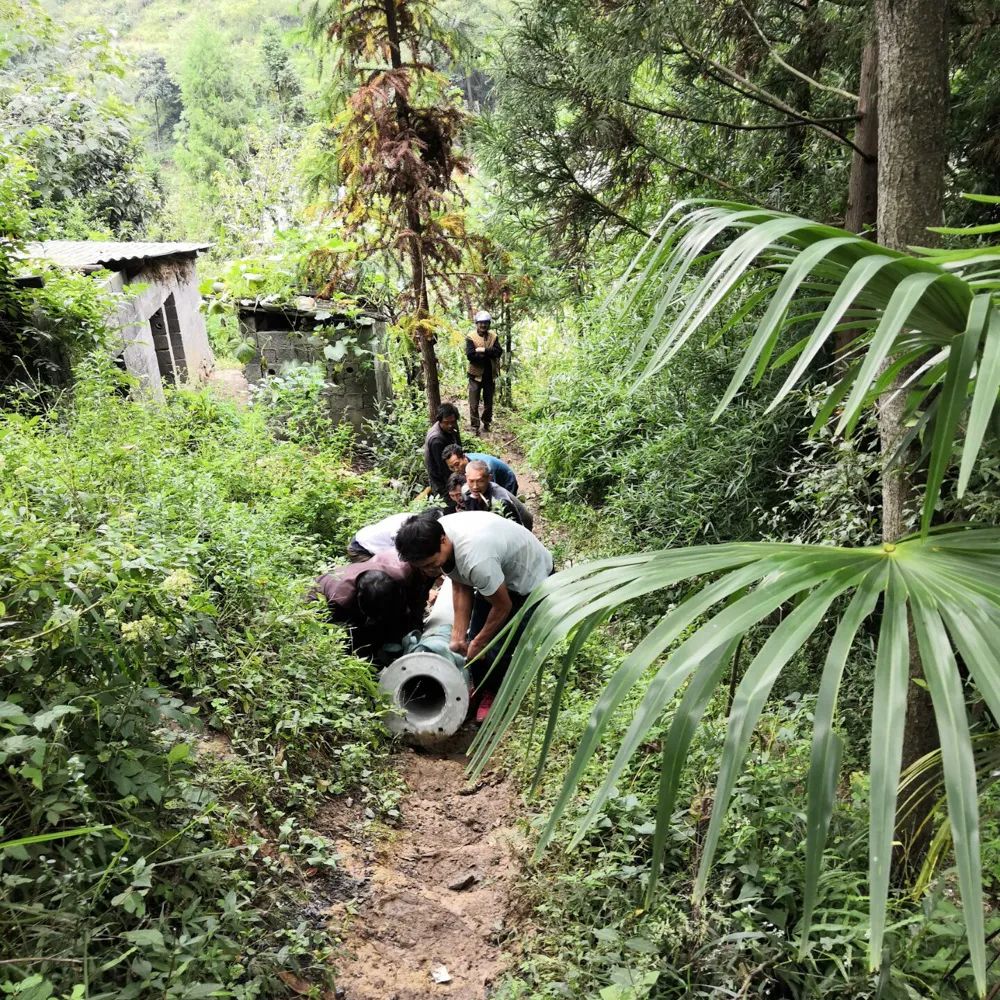
Will mountain residents get 5G? Probably not for a long time: today's 5G hasn't visibly raised carriers' ARPU, yet it carries very real construction and operating costs — more base stations, more equipment, more power and bigger electricity bills. With too few 5G users, too little data demand, and no must-have reason to use 5G, building it there simply doesn't pay.
There is still a lot of work before 5G never drops — in Beijing, in hyper-dense Huaguoyuan in Guiyang, and equally in sparsely populated towns and mountain areas.
But Bijie's case tells us that beyond 5G, many more people need the more basic 4G — and for them its value is indeed far higher than letting us download a game over 5G once in a while.
Republished from: https://tele.ofweek.com/2020-12/ART-8320500-8420-30475121.html
Quantum Responses (0)